

AFFILIAZIONE
Istituto Clinico Ligure Alta Specialita’
AUTORE PRINCIPALE
Dott. Carrozzo Alessandro
Registrazione obbligatoria. Una valutazione consentita
GRUPPO DI LAVORO
AREA TEMATICA
Applicazioni di intelligenza artificiale in sanità
ABSTRACT
Mitral valve repair is the preferred treatment for degenerative mitral regurgitation, yet its reproducibility remains limited across centres, particularly outside high-volume institutions. This variability is largely related to the absence of structured preoperative planning, as echocardiographic imaging, although increasingly detailed, does not directly translate into a defined surgical strategy.
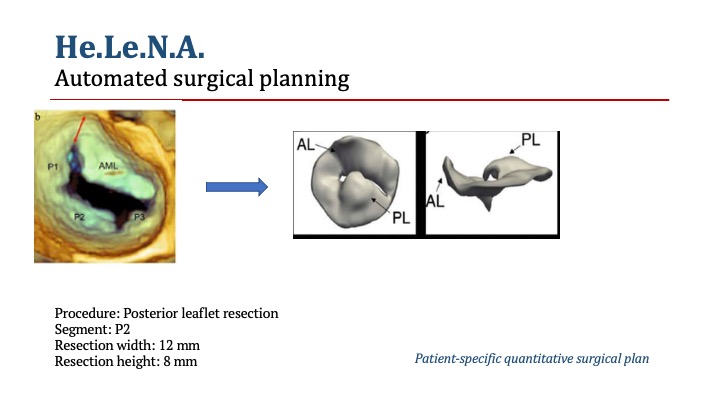
He.Le.N.A. is a decision-support system designed to bridge this gap by transforming echocardiographic data into a quantitative and patient-specific surgical plan. The software integrates 2D and 3D echocardiographic datasets to reconstruct the mitral valve and generate a geometric model of the patient-specific anatomy. This model is compared with a functionally ideal configuration derived from established surgical principles, enabling the definition of a structured operative strategy.
The decision engine is based on explicit rule-based logic derived from surgical knowledge, combined with iterative refinement on real-world cases to ensure coherence with clinical practice and reproducibility across datasets.
The output consists of a complete surgical plan including identification of the pathological segment, selection of the repair technique, quantitative definition of the surgical correction and prediction of the post-repair valve configuration. The system was applied to 50 real-world mitral valve cases, and the generated plans were compared with surgical strategies, focusing on segment identification and treatment selection.
A complete surgical plan was generated in 100% of cases. High agreement with surgical strategy (~80–85%) was observed, consistent with known variability in clinical decision-making, with target segment identification exceeding 90%.
He.Le.N.A. demonstrates the feasibility of integrating imaging and decision-making into a unified clinical workflow, with the potential to reduce variability, support training and improve the scalability of mitral valve repair. This represents a pilot feasibility experience, and further prospective validation is required.
He.Le.N.A. is a decision-support system designed to bridge this gap by transforming echocardiographic data into a quantitative and patient-specific surgical plan. The software integrates 2D and 3D echocardiographic datasets to reconstruct the mitral valve and generate a geometric model of the patient-specific anatomy. This model is compared with a functionally ideal configuration derived from established surgical principles, enabling the definition of a structured operative strategy.
The decision engine is based on explicit rule-based logic derived from surgical knowledge, combined with iterative refinement on real-world cases to ensure coherence with clinical practice and reproducibility across datasets.
The output consists of a complete surgical plan including identification of the pathological segment, selection of the repair technique, quantitative definition of the surgical correction and prediction of the post-repair valve configuration. The system was applied to 50 real-world mitral valve cases, and the generated plans were compared with surgical strategies, focusing on segment identification and treatment selection.
A complete surgical plan was generated in 100% of cases. High agreement with surgical strategy (~80–85%) was observed, consistent with known variability in clinical decision-making, with target segment identification exceeding 90%.
He.Le.N.A. demonstrates the feasibility of integrating imaging and decision-making into a unified clinical workflow, with the potential to reduce variability, support training and improve the scalability of mitral valve repair. This represents a pilot feasibility experience, and further prospective validation is required.