

AFFILIAZIONE
Insideai
AUTORE PRINCIPALE
Dr. Coro Florinda
Registrazione obbligatoria. Una valutazione consentita
GRUPPO DI LAVORO
AREA TEMATICA
Applicazioni innovative di ingegneria per la sanità: idee dalle Università
ABSTRACT
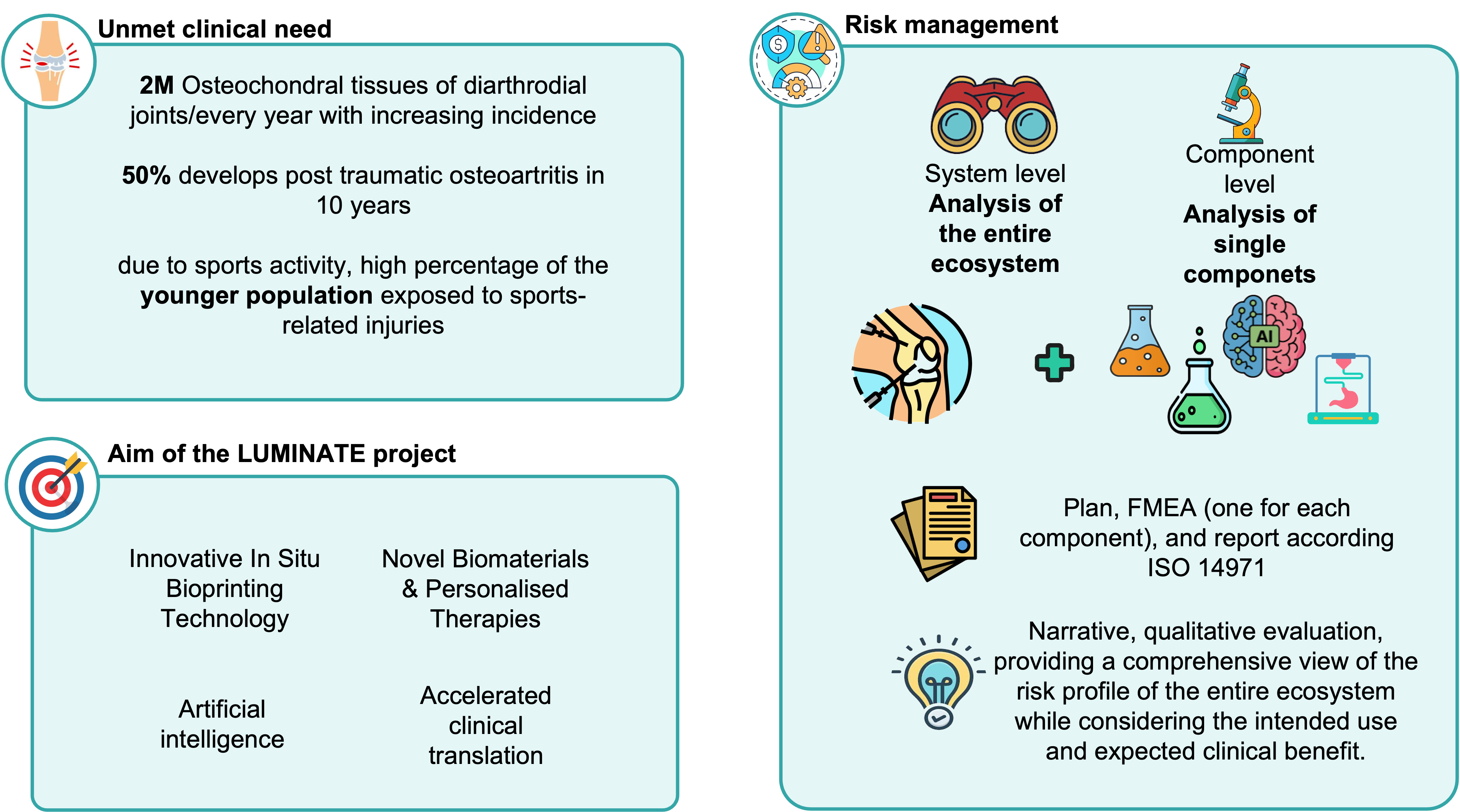
Over two million people each year suffer from traumatic cartilage injuries in diarthrodial joints such as the knee. Current treatments often result in disabling post-traumatic osteoarthritis, highlighting a critical need for advanced therapies. The LUMINATE project addresses this need with a personalized, single-stage treatment. The LUMINATE ecosystem combines medical devices and Advanced Therapy Medicinal Products (ATMPs) to support osteochondral regeneration. An AI-powered arthroscope deposits and crosslinks two novel bioinks: a cell-free bioink promoting bone regeneration and a cell-laden bioink containing off-the-shelf iMSC and autologous chondrons to promote cartilage regeneration, enabling personalized and rapid recovery. To ensure regulatory compliance, a comprehensive risk assessment was conducted according to ISO 14971, supported by ISO/TR 24971 for practical guidance. The analysis was performed at two levels. First, a system-level evaluation considered interactions among the technologies and their impact on the intended use of the complete ecosystem. Second, each component was analysed individually, accounting for regulatory requirements and the technical and functional characteristics of each device. For every element, a dedicated FMEA (Failure Mode and Effects Analysis) identifies potential failure modes, root causes, and consequences on the intended use, expressed in terms of severity and probability of harm. The documentation includes a Risk Management Plan, a Risk Management Report, a list of structured questions following Annex A of ISO/TR 24971, and an FMEA for each device. Results from individual analyses were integrated into a system-level assessment. The final evaluation is a narrative, qualitative appraisal, providing a comprehensive view of the risk profile of the entire ecosystem while considering the intended use and expected clinical benefit. This integrated risk assessment serves as a key design input, actively guiding the development of the LUMINATE system. Furthermore, it establishes a solid foundation for the development and structuring of the Technical File, supporting future activities, including verification, validation, and subsequent phases of the project lifecycle.